S-expressions that compile to native executables
Lisp at the speed of thought -- AOT compiled to C++23 -- zero dependencies
.nls
➜
Tokenizer
➜
Parser
➜
Macros
➜
Analyzer
➜
C++23
➜
zig/clang
➜
.exe
Core complete
The Language
Homoiconic Lisp, native output
Write S-expressions. The compiler expands macros, optimizes tail calls, emits C++23, and builds a standalone binary.
hello.nls
// A complete program in NitroLISP
(module exe hello
  (import testlib)

  (defn greet ((name : string) (times : int32)) : void
    (for (i 1 to times)
      (println "Hello, {}! ({})" name i)))

  (greet "NitroLISP" 3)
  (println "triple(7) = {}"
    (testlib.lib_triple 7)))
Terminal
$ NLC -s hello.nls -r

Hello, NitroLISP! (1)
Hello, NitroLISP! (2)
Hello, NitroLISP! (3)
triple(7) = 21
Features
Everything built in. Nothing to install.
Tokenizer, parser, macro expander, analyzer, C++ emitter, and zig/clang toolchain in one invocation.
Zero Dependencies
Pure Delphi engine, bundled zig/clang toolchain. One tool produces standalone native binaries.
AOT to C++23
S-expressions compile to clean, readable C++23. No interpreter, no VM, no bytecode layer in the output.
Real Macro System
defmacro with quasiquote, unquote, and splicing. Compile-time code transformation with gensym hygiene.
EXE, DLL, and LIB
Same source compiles to executables, dynamic libraries, or reusable library modules. Module declaration drives the output.
Built-in Debugger
Debug Adapter Protocol support provides breakpoints, stepping, call stacks, and variable inspection in VS Code.
Language Server
LSP integration delivers diagnostics, completion, hover, go-to-definition, and references in your editor.
Tail Call Optimization
Recursive algorithms that would blow the stack run in constant space. Verified at 1 million depth.
Cross-Platform
Target Win64 and Linux64 from the same source. Switch with one directive: @target linux64.
C++ Interop
Inline C++ passthrough, #include any header, declare external symbols. NitroLISP and C++ share one translation unit.
Use Cases
Built for people who ship native code
Whether you want Lisp expressiveness with native speed, or a scripting layer that compiles to machine code.
Game Developers
Scripting-language expressiveness with native compilation. Macros let you build domain-specific forms that compile away to zero overhead.
Systems Programmers
Records with bitfields and packed layout, typed pointers, inline C++ passthrough, and direct memory management. Lisp syntax, systems-level control.
Lisp Enthusiasts
A real Lisp with defmacro, quasiquote, closures, and tail-call optimization that compiles to native executables instead of running on a VM.
Embedding Scenarios
Compile NitroLISP modules as DLLs with a C-callable API, link library modules directly, or embed a NitroLISP-written interpreter for runtime scripting.
Media
See NitroLISP in action
Infographic, walkthroughs, and a deep dive into the compiler architecture.
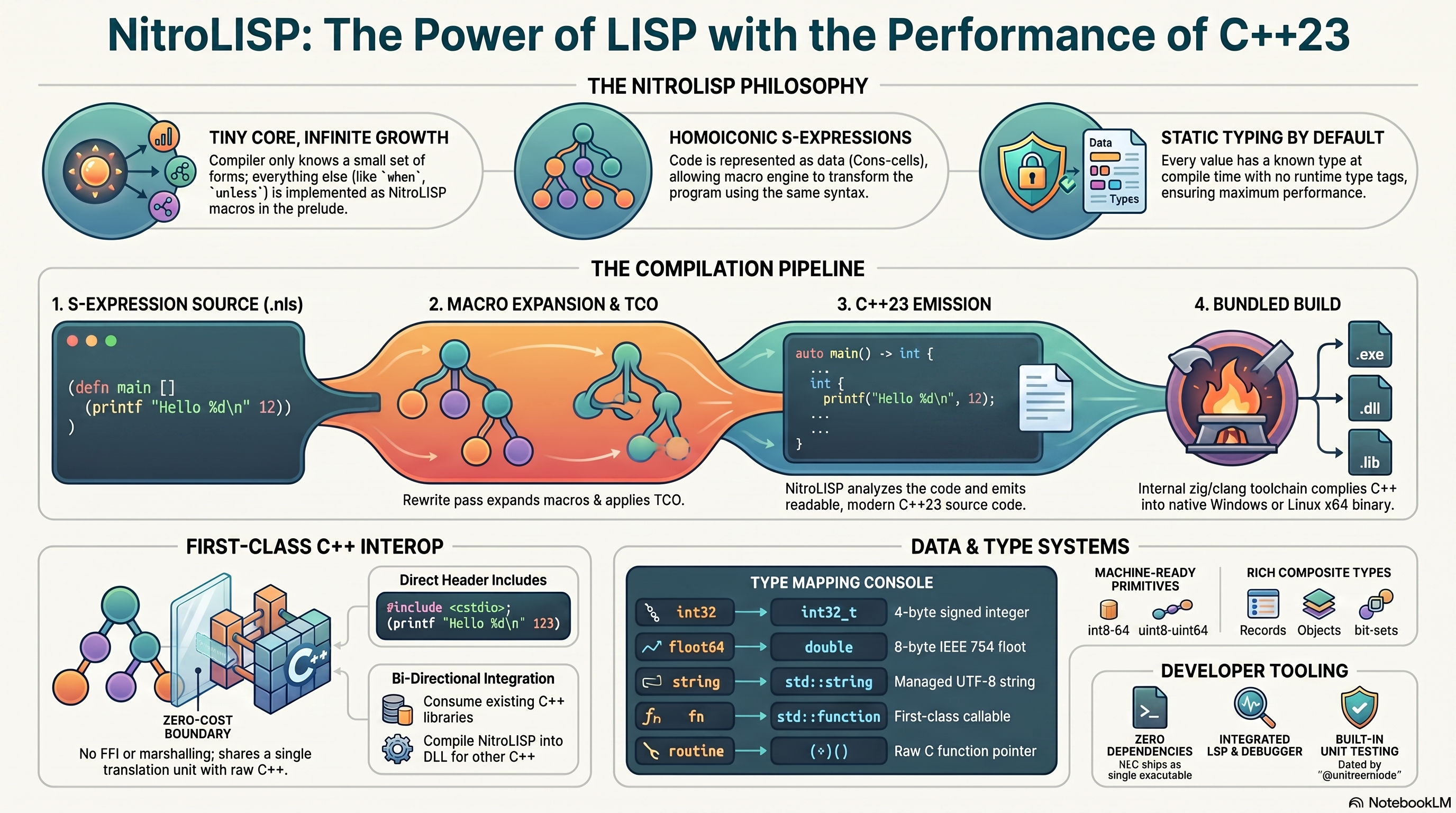
Deep Dive -- Compiler Architecture
Use the expand button to view full size
Get Started
Three steps to native code
No SDK, no package manager, no setup wizard.
01
Write a source file
// hello.nls
(module exe hello
(println "Hello!"))
02
Compile and run
$ NLC -s hello.nls -r
Hello!
03
Ship it
$ dir output\
hello.exe 32,768 bytes
// That's it. No runtime.